How U.S. Fell Under the Spell of ‘Curveball’
The German intelligence officials responsible for one of the most important informants on Saddam Hussein’s suspected weapons of mass destruction say that the Bush administration and the CIA repeatedly exaggerated his claims during the run-up to the war in Iraq.
Five senior officials from Germany’s Federal Intelligence Service, or BND, said in interviews with The Times that they warned U.S. intelligence authorities that the source, an Iraqi defector code-named Curveball, never claimed to produce germ weapons and never saw anyone else do so.
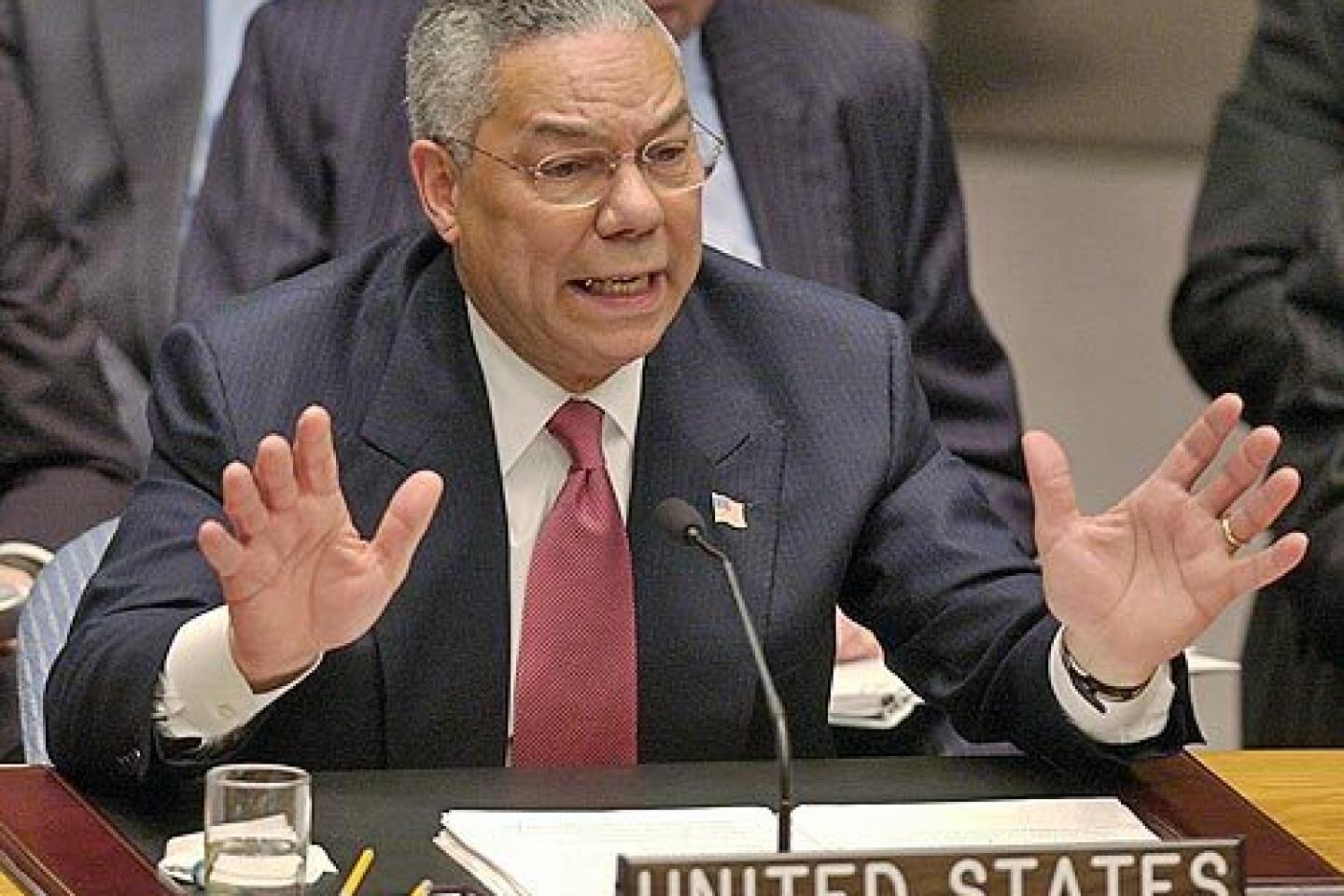
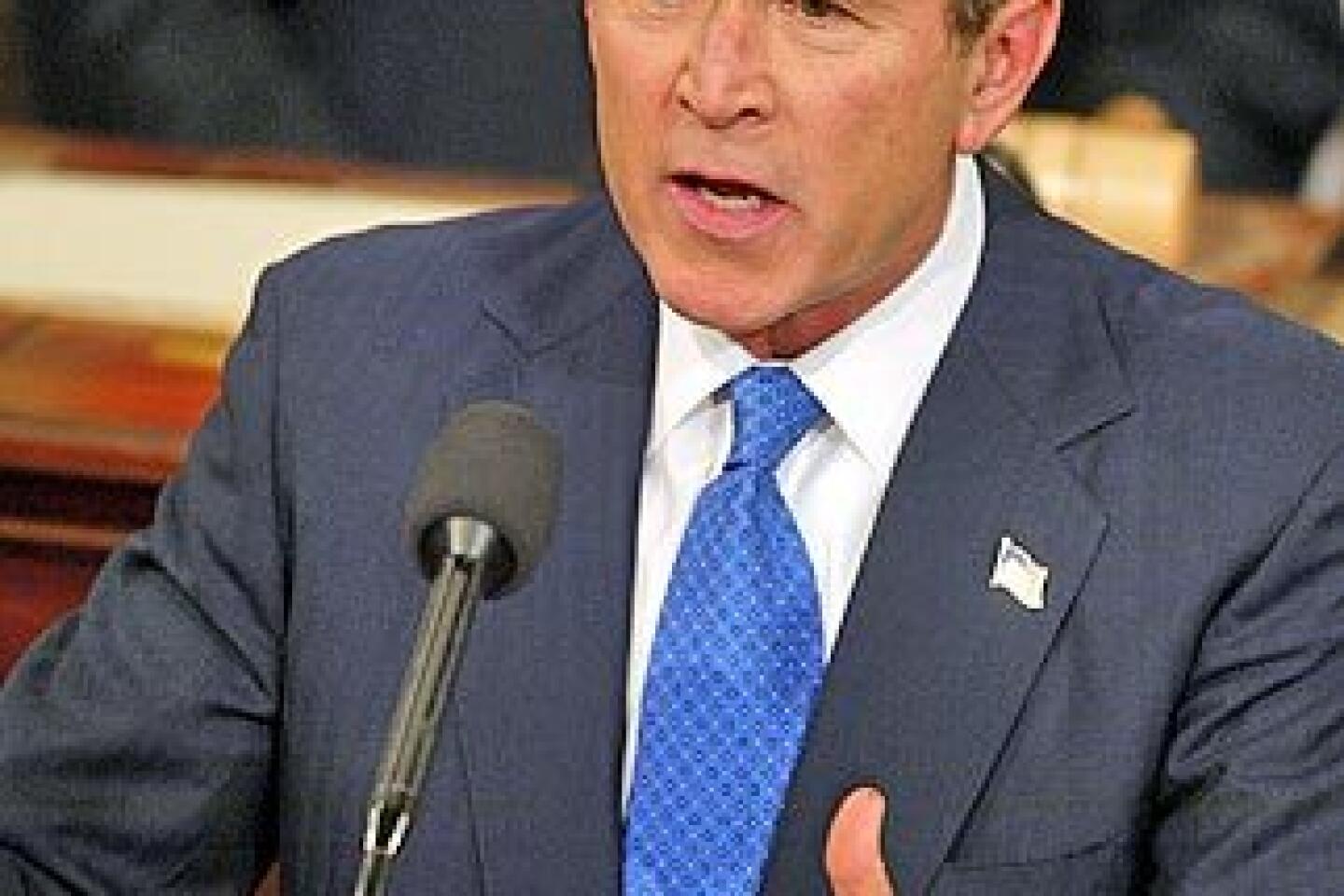
According to the Germans, President Bush mischaracterized Curveball’s information when he warned before the war that Iraq had at least seven mobile factories brewing biological poisons. Then-Secretary of State Colin L. Powell also misstated Curveball’s accounts in his prewar presentation to the United Nations on Feb. 5, 2003, the Germans said.
Curveball’s German handlers for the last six years said his information was often vague, mostly secondhand and impossible to confirm.
“This was not substantial evidence,” said a senior German intelligence official. “We made clear we could not verify the things he said.”
The German authorities, speaking about the case for the first time, also said that their informant suffered from emotional and mental problems. “He is not a stable, psychologically stable guy,” said a BND official who supervised the case. “He is not a completely normal person,” agreed a BND analyst.
Curveball was the chief source of inaccurate prewar U.S. accusations that Baghdad had biological weapons, a commission appointed by Bush reported this year. The commission did not interview Curveball, who still insists his story was true, or the German officials who handled his case.
The German account emerges as the White House is lashing out at domestic critics, particularly Senate Democrats, over allegations the administration manipulated intelligence to go to war. Last week, Vice President Dick Cheney called such claims reprehensible and pernicious.
In Congress, the Senate Select Committee on Intelligence is resuming its long-stalled investigation of the administration’s use of prewar intelligence. Committee members said last week that the Curveball case would be a key part of their review. House Democrats are calling for a similar inquiry.
An investigation by The Times based on interviews since May with about 30 current and former intelligence officials in the U.S., Germany, England, Iraq and the United Nations, as well as other experts, shows that U.S. bungling in the Curveball case was worse than official reports have disclosed.
The White House, for example, ignored evidence gathered by United Nations weapons inspectors shortly before the war that disproved Curveball’s account. Bush and his aides issued increasingly dire warnings about Iraq’s biological weapons before the war even though intelligence from Curveball had not changed in two years.
At the Central Intelligence Agency, officials embraced Curveball’s account even though they could not confirm it or interview him until a year after the invasion. They ignored multiple warnings about his reliability before the war, punished in-house critics who provided proof that he had lied and refused to admit error until May 2004, 14 months after the invasion.
After the CIA vouched for Curveball’s accounts, Bush declared in his 2003 State of the Union speech that Iraq had “mobile biological weapons labs” designed to produce “germ warfare agents.” Bush cited the mobile germ factories in at least four prewar speeches and statements, and other world leaders repeated the charge.
Powell also highlighted Curveball’s “eyewitness” account when he warned the United Nations Security Council on the eve of war that Iraq’s mobile labs could brew enough weapons-grade microbes “in a single month to kill thousands upon thousands of people.”
The senior BND officer who supervised Curveball’s case said he was aghast when he watched Powell misstate Curveball’s claims as a justification for war.
“We were shocked,” the official said. “Mein Gott! We had always told them it was not proven.... It was not hard intelligence.”
In a telephone interview, Powell said that George J. Tenet, then the director of central intelligence, and his top deputies personally assured him before his U.N. speech that U.S. intelligence on the mobile labs was “solid.” Since then, Powell said, the case “has totally blown up in our faces.”
Many officials interviewed for this report, including the German intelligence officers, spoke on the condition they not be identified because they were bound by secrecy agreements, were not authorized to speak to the news media or because the case involved classified sources and methods.
Curveball lives under an assumed name in southern Germany. The BND has given him a furnished apartment, language lessons and a stipend generous enough that he does not need to work. His wife has emigrated from Iraq, and they have an infant daughter.
The BND has relocated him twice because of concerns that his life was in danger. They still watch him closely. “He is difficult to integrate” into local society, said a BND operations officer. “We are still busy with him.”
Curveball could not be interviewed for this report. BND officials threatened last summer to strip him of his salary, housing and protection if he agreed to meet with The Times.
“We told him, ‘If you talk to anyone on the outside... you are out and you get no more help from us,’ ” the BND supervisor said.
CIA officials now concede that the Iraqi fused fact, research he gleaned on the Internet and what his former co-workers called “water cooler gossip” into a nightmarish fantasy that played on U.S. fears after the Sept. 11 attacks.
Curveball’s motive, CIA officials said, was not to start a war. He simply was seeking a German visa.
German journey
The Curveball chronicle began in November 1999, when the dark-haired Iraqi in his late 20s flew into Munich’s Franz Josef Strauss Airport with a tourist visa.
The Baghdad-born chemical engineer promptly applied for political asylum in Arabic and halting English. He told German immigration officials he had embezzled Iraqi government money and faced prison or worse if sent home.
The Germans sent him to Zirndorf, a refugee center near Nuremberg once used for Soviet defectors, where he joined a long line of Iraqi exiles seeking German visas.
Abruptly, his story changed.
He once led a team, he told BND officers, that equipped trucks to brew deadly bio-agents. He named six sites where Iraq might be hiding biological warfare vehicles. Three already were operating. A farm program to boost crop yields was cover for Iraq’s new biological weapons production program, he said.
Germany provided Europe’s most generous benefits to Iraqi refugees, and several hundred arrived each month. But few had useful credible intelligence on Baghdad’s suspected weapons programs. Intelligence agents became accustomed to exaggerated claims.
“The Iraqis were adept at feeding us what we wanted to hear,” said a former official of the Pentagon’s Defense Intelligence Agency who helped debrief about 50 Iraqi emigres in Germany before the war. “Most of it was garbage.’’
But for this defector, the Germans assigned two case officers as well as a team of chemists, biologists and other experts. They debriefed him from January 2000 to September 2001.
Since the Iraqi had arrived in Munich, U.S. liaison with German intelligence was assigned to the local DIA team. Their clandestine operating base was an elegant 19th century mansion known as Munich House. There he was assigned his codename: Curveball.
The base cryptonym “ball” was used to signify weapons, two former U.S. intelligence officials said. An earlier informant in Germany, for example, was called Matchball.
In DIA files, Iraqi sources were listed as “red” if U.S. intelligence could interview them. Curveball was a “blue” source, meaning the Germans would not permit U.S. access to him.
Curveball said he hated Americans, the Germans explained.
As a result, the DIA -- like the BND -- never tried to check Curveball’s background or verify his accounts before sending reports to other U.S. intelligence agencies. Despite that failure, CIA analysts accepted the incoming reports as credible and quickly passed them to senior policymakers.
The reports had problems, however. The Germans usually interviewed Curveball in Arabic, using a translator, although the Iraqi sometimes spoke English.
“But a case officer wants to speak directly to his source,” said the senior BND officer. “Curveball began to learn German, and thus there was a big mix [of languages] that went on. This explains some of the confusion.”
It got worse, like a children’s game of “telephone,” in which information gets increasingly distorted. The BND sent German summaries of their English and Arabic interview reports to Munich House and to British intelligence. The DIA team translated the German back to English and prepared its own summaries. Those went to DIA’s directorate for human intelligence, at a high-rise office in Clarendon, Va.
Clarendon passed 95 DIA reports to the Weapons Intelligence, Non-Proliferation and Arms Control Center, known as WINPAC, at CIA headquarters in nearby Langley. Experts there called other specialists, including an independent laboratory, to help evaluate the data. Spy satellites were directed to focus on Curveball’s sites. CIA artists prepared detailed drawings from Curveball’s crude sketches.
The system led to confusion, not clarity.
“Analysts were studying drawings made by artists working from descriptions by a guy we couldn’t talk to,” explained a former senior CIA official who helped supervise the case and the postwar investigation. “It was hard to figure out.”
“Our fear is that as it was analyzed and translated and reanalyzed and retranslated, and comments got added, it could have gotten sexed up by accident,” agreed a former CIA operations official.
The British Secret Intelligence Service, known as MI6, blamed the BND for omitting what a Parliamentary inquiry called “significant detail” in the reports they sent to London. At issue were Curveball’s trucks.
In an e-mail to The Times, Robin Butler, head of the British inquiry into prewar intelligence, said “incomplete reporting” by the BND misled the British to assume the trucks could produce weapons-grade bio-agents such as anthrax spores. But Curveball only spoke of producing a liquid slurry unsuitable for bombs or warheads.
At the CIA, bio-warfare experts viewed the defector’s reports as sophisticated and technically feasible. They also matched the analysts’ expectations.
After the 1991 Gulf War, U.N. inspectors struggled to unravel Baghdad’s secret biological weapons program. They speculated that the regime produced germs in mobile factories to evade detection.
American U-2 spy planes looked for suspicious vehicles, and U.N. teams raided parking lots.
In 1994, acting on tips from Israeli intelligence, U.N. inspectors even stopped red-and-white trucks in Baghdad marked: “Tip Top Ice Cream.” Inside they found ice cream.
“We thought they could easily transport other materials around,” said Rolf Ekeus, who headed the U.N. inspectors from 1991 to 1997.
Finally, in mid-1995, Iraq officials admitted that before the Gulf War they had secretly produced 30,000 liters of anthrax, botulinum toxin, aflatoxin and other lethal bio-agents. They had deployed hundreds of germ-filled munitions and researched other deadly diseases for military use. They denied they ever had mobile production facilities.
Curveball’s story to the Germans in 2000 and 2001 neatly dovetailed with that history and continuing CIA suspicions.
The Iraqi defector said he was recruited out of engineering school at Baghdad University in 1994 by Iraq’s Military Industrial Commission, headed by Saddam Hussein’s son-in-law Hussein Kamil. He said he went to work the following year for “Dr. Germ,” British-trained microbiologist Rihab Rashid Taha, to build bio-warfare vehicles. Kamil and Taha had headed the pre-1991 bio-weapons program.
Curveball said he was assigned to the Chemical Engineering and Design Center, behind the Rashid Hotel in central Baghdad.
That also fit a pattern, as the center provided a cover story for Iraq’s first bio-warfare program .
Curveball said he had helped assemble one truck-mounted germ factory in 1997 at Djerf al Nadaf, a tumble-down cluster of warehouses in a gritty industrial area 10 miles southeast of Baghdad. He helped the Germans build a scale model of the facility, showing how vehicles were hidden in a two-story building -- and how they entered and exited on either end.
He designed laboratory equipment for the trucks, he said, providing dimensions, temperature ranges and other details. He sketched diagrams of how the system operated, and identified more than a dozen co-workers.
But the story had holes .
“His information to us was very vague,” said the senior German intelligence official. “He could not say if these things functioned, if they worked.”
Curveball also said he could not identify what microbes the trucks were designed to produce.
“He didn’t know ... whether it was anthrax or not,” said the BND supervisor. “He had nothing to do with actual production of [a biological] agent. He was in the equipment testing phase. And the equipment worked.”
David Kay, who read the Curveball file when he headed the CIA’s search for hidden weapons in 2003, said Curveball’s accounts were maddeningly murky.
“He was not in charge of trucks or production,” Kay said. “He had nothing to do with actual production of biological agent. He never saw them actually produce [an] agent.”
But the CIA and the White House overlooked the holes in the story.
In a February 2003 radio address and statement, Bush warned that “first-hand witnesses have informed us that Iraq has at least seven mobile factories” for germ warfare. With these, Bush said, “Iraq could produce within just months hundreds of pounds of biological poisons.”
Curveball had told the Germans that Taha’s team planned to build mobile factories at six sites across Iraq, from Numaniyah in the south to Tikrit in the north. But he visited only Djerf al Nadaf, he said. His information about the other sites, he told the Germans, was second-hand.
Flawed witness
Curveball’s reports were highly valued in Washington because the CIA had no Iraqi spies with access to weapons programs at the time.
One detail particularly impressed the CIA: Curveball’s report of a 1998 germ weapons accident at Djerf al Nadaf. Powell cited the incident in his prewar U.N. speech. An “eyewitness” was “at the site” when an accident occurred, and 12 technicians “died from exposure to biological agents,” Powell said.
Lawrence B. Wilkerson, then Powell’s chief of staff, said senior CIA officials told Powell the “principal source had not only worked in mobile labs but had seen an accident and had been injured in the accident.... This gave more credibility to it.”
But German intelligence officials said the CIA was wrong. Curveball only “heard rumors of an accident,” the BND supervisor said. “He gave a third-hand account.”
The incident led to the first questions inside the CIA about Curveball’s credibility. In May 2000, the Germans allowed a doctor from the CIA’s counter-proliferation branch to meet Curveball and draw a blood sample. Antibodies in the blood could indicate if he had been exposed to anthrax or other unusual pathogens in the accident.
The medical tests were inconclusive, but the meeting was memorable.
The BND, insisting Curveball spoke no English and would not meet Americans, introduced the doctor as a German. The CIA physician remained silent, because he was not fluent in German. He was surprised, he later told others, that Curveball spoke “excellent English” to others in the room.
Moreover, Curveball was “very emotional, very excitable,” the doctor told one colleague. And although it was early morning, Curveball smelled of liquor and looked “very sick” from a stiff hangover.
German intelligence officials said Curveball didn’t have a drinking problem. But they had other concerns.
Like many defectors, Curveball at first seemed eager to please. He thanked his new friends and laughed at their jokes. He was charming and clearly intelligent, providing complex engineering details.
But as the questions intensified, Curveball grew moody and irritable. His memory began to fail. He confused places and dates. He fretted about his personal safety, about his parents and wife in Baghdad, and about his future in Germany.
“He was between two worlds, sometimes cooperative, sometimes aggressive,” said the BND supervisor. “He was not an easy-going guy.”
Curveball largely ceased cooperating in 2001 after he was granted asylum, officials said. He would refuse to meet for days, and then weeks, at a time. He also increasingly asked for money.
“He knew he was important,” said the BND analyst. “He was not an idiot.”
Defectors are often problem sources. Viewed as traitors back home, many embellish their stories to gain favor with spy services. In the shadow world of intelligence, Curveball’s inability or reluctance to provide many details actually helped convince analysts he was telling the truth.
Had Curveball claimed expertise with biological weapons or direct access to other secret programs, said the BND analyst, “It would be easier to assume he was lying.”
A former British official involved with the case said Curveball’s behavior should be seen through another lens. He is convinced that Curveball was under intense stress, terrified both that his visa scam would be exposed, and that his lies would be used to start a war.
“He must have been scared out of his mind,” he said.
But concerns about Curveball’s reliability were growing. In early 2001, the CIA’s Berlin station chief sent a message to headquarters noting that a BND official had complained that the Iraqi was “out of control,” and couldn’t be located, Senate investigators found.
MI6 cabled the CIA that British intelligence “is not convinced that Curveball is a wholly reliable source” and that “elements of [his] behavior strike us as typical of ... fabricators,’’ the presidential commission reported.
British intelligence also warned that spy satellite images taken in 1997 when Curveball claimed to be working at Djerf al Nadaf conflicted with his descriptions. The photos showed a wall around most of the main warehouse, clearly blocking trucks from getting in or out.
U.S. and German officials feared that Ahmad Chalabi had coached Curveball after the defector said his brother had worked as a bodyguard for the controversial Iraqi exile leader. But they found no evidence.
Curveball “had very little contact with his [bodyguard] brother,” the BND supervisor said. “They are not close.’’
More problematic were the three sources the CIA said had corroborated Curveball’s story. Two had ties to Chalabi. All three turned out to be frauds.
The most important, a former major in the Iraqi intelligence service, was deemed a liar by the CIA and DIA. In May 2002, a fabricator warning was posted in U.S. intelligence databases.
Powell said he was never warned, during three days of intense briefings at CIA headquarters before his U.N. speech, that he was using material that both the DIA and CIA had determined was false. “As you can imagine, I was not pleased,” Powell said. “What really made me not pleased was they had put out a burn notice on this guy, and people who were even present at my briefings knew it.”
But BND officials said their U.S. colleagues repeatedly assured them Curveball’s story had been corroborated.
“They kept on telling us there were three or four sources,” said the senior German intelligence official. “They said it many times.”
Behind the scenes, the CIA stepped up pressure to interview Curveball. The BND finally accepted a compromise in the fall of 2002. They let CIA analysts send questions, but they could not interview the Iraqi.
The frustration was intense at the CIA. But it wasn’t surprising.
Relations long have been rocky between the CIA and BND, officials in both spy services acknowledged. The friction dates to the Cold War, when the BND complained it was treated as a second-class agency.
Spy services jealously guard their sources, and the BND was not obligated to share access to Curveball. “We would never let them see one of ours,” said the former CIA operations officer.
Intelligence shift
Despite the lack of access or any new reports from Curveball, U.S. intelligence sharply upgraded its assessments of Iraq’s biological weapons before the war. The shift is reflected in declassified portions of National Intelligence Estimates, which are produced as the authoritative judgment of the 15 U.S. intelligence agencies.
In May 1999, before Curveball defected, a national intelligence estimate on worldwide biological warfare programs said Iraq was “probably continuing work to develop and produce BW [bio-warfare] agents,” and could restart production in six months.
In December 2000, after a year of Curveball’s reports, another national intelligence estimate cautiously noted that “new intelligence” had caused U.S. intelligence “to adjust our assessment upward” and “suggests Baghdad has expanded’’ its bio-weapons program.
But the caveats disappeared after the Sept. 11 attacks and the still-unsolved mailing of anthrax-laced letters to several U.S. states.
Iraq “continues to produce at least ... three BW agents” and its mobile germ factories provide “capabilities surpassing the pre-Gulf War era,” the CIA weapons center warned in October 2001. The CIA followed up with a public White Paper and briefings for the White House and three Senate committees.
The CIA hadn’t seen new intelligence on Iraq’s germ weapons. Instead, analysts had estimated what they believed would be the maximum output from seven mobile labs -- only one of which Curveball said he had seen -- operating nonstop or six months. But even Curveball’s description of a single lab was a fiction.
Similar misjudgments filled the most important prewar intelligence document, the National Intelligence Estimate issued in October 2002. It was sent to Congress days before lawmakers voted to authorize use of military force if Hussein refused to give up his illicit arsenal.
For the first time, the new estimate warned with “high confidence” that Iraq “has now established large-scale, redundant and concealed BW agent production capabilities.”
It said “all key aspects” of Iraq’s offensive BW program “are active and that most elements are larger and more advanced than they were before the Gulf War.”
The assessment was based “largely on information from a single source -- Curveball,” the presidential commission concluded. It was one of “the most important and alarming” judgments in the document, the panel added. And it was utterly wrong.
A handful of bio-analysts in the weapons center, part of the CIA’s intelligence directorate, controlled the Curveball reports and remained confident in their veracity. But across the CIA bureaucracy, the clandestine service officers who usually handle defectors and other human sources were increasingly skeptical.
Tyler Drumheller, then the head of CIA spying in Europe, called the BND station chief at the German embassy in Washington in September 2002 seeking access to Curveball.
Drumheller and the station chief met for lunch at the German’s favorite seafood restaurant in upscale Georgetown. The German officer warned that Curveball had suffered a mental breakdown and was “crazy,” the now-retired CIA veteran recalled.
“He said, first off, ‘They won’t let you see him,’ ” Drumheller said. “ ‘Second, there are a lot of problems. Principally, we think he’s probably a fabricator.’ ”
The BND station chief, contacted by The Times during the summer, said he could not “discuss any of this.” He has since been reassigned back to Germany. His BND supervisors declined to discuss the lunch meeting.
Drumheller, a veteran of 26 years in the CIA clandestine service, said he and several aides repeatedly raised alarms after the lunch in tense exchanges with CIA analysts working on the Curveball case.
“The fact is, there was a lot of yelling and screaming about this guy,” said James Pavitt, then chief of clandestine services, who retired from the CIA in August 2004. “My people were saying, ‘We think he’s a stinker.’ ”
The analysts refused to back down. In one meeting, the chief analyst fiercely defended Curveball’s account, saying she had confirmed on the Internet many of the details he cited. “Exactly, it’s on the Internet!” the operations group chief for Germany, now a CIA station chief in Europe, exploded in response. “That’s where he got it too,” according to a participant at the meeting.
Other warnings poured in. The CIA Berlin station chief wrote that the BND had “not been able to verify” Curveball’s claims. The CIA doctor who met Curveball wrote to his supervisor shortly before Powell’s speech questioning “the validity” of the Iraqi’s information.
“Keep in mind that this war is going to happen regardless of what Curve Ball said or didn’t say and the Powers That Be probably aren’t terribly interested in whether Curve Ball knows what he’s talking about,” his supervisor wrote back, Senate investigators found. The supervisor later told them he was only voicing his opinion that war appeared inevitable.
Tenet has denied receiving warnings that Curveball might be a fabricator. He declined to be interviewed for this report.
Powell said that at the time he prepared for his U.N. speech in early 2003, no one warned him of the debate inside the CIA over Curveball’s credibility. “I was being as careful as I possibly could,” he said.
Working from a CIA conference room adjoining CIA Director Tenet’s seventh-floor office suite, Powell and his aides repeatedly challenged the credibility of CIA evidence -- including the mobile germ factories.
“We pressed as hard as we could, and the CIA stood by it adamantly,” Powell recalled. “This is one we really pressed on, really spent a lot time on.... We knew how important it was.”
No smoking gun
On Feb. 5, 2003, Powell told the packed U.N. chamber that his account was based on “solid sources” and “facts and conclusions based on solid intelligence.” “We thought maybe they had the smoking gun,” recalled the BND supervisor, who watched Powell on TV. “My gut feeling was the Americans must have so much from reconnaissance planes and satellites, from infiltrated spotter teams from Special Forces, and other systems. We thought they must have tons of stuff.”
Instead, Powell emphasized Curveball’s “eyewitness” account, calling it “one of the most worrisome things that emerge from the thick intelligence file.”
A congressional staffer on intelligence said she realized the case was weak when she saw Powell display CIA drawings of trucks but not photos. “A drawing isn’t evidence,” she said. “It’s hearsay.”
Powell’s speech failed to sway many diplomats, but it had an immediate impact in Baghdad.
“The Iraqis scoured the country for trailers,” said a former CIA official who helped interrogate Iraqi officials and scientists in U.S. custody after the war. “They were in real panic mode. They were terrified that this was real, and they couldn’t explain it.”
An explanation was available within days, but U.S. officials ignored it.
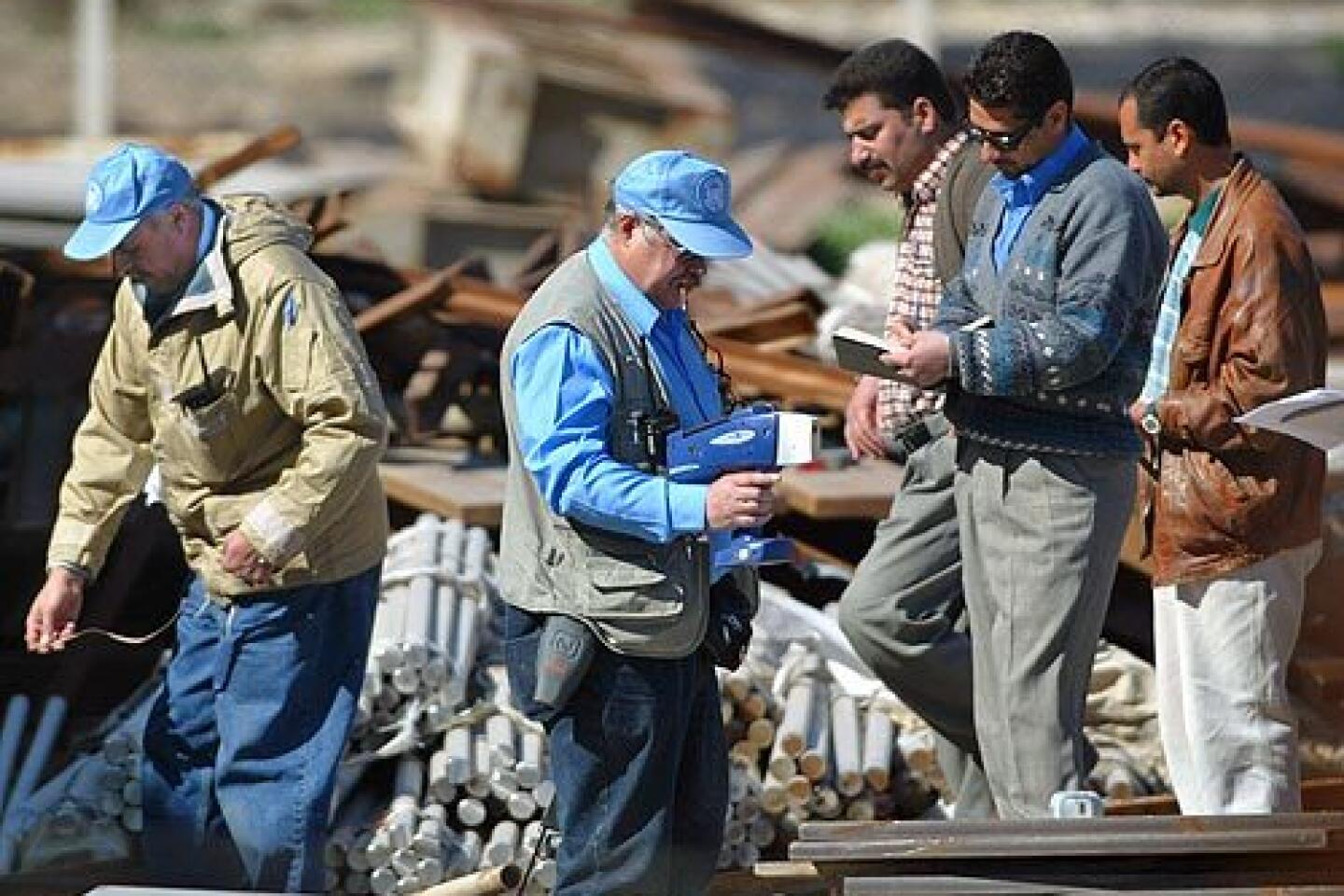
On Feb. 8, three days after Powell’s speech, the U.N.’s Team Bravo conducted the first search of Curveball’s former work site. The raid by the American-led biological weapons experts lasted 3 1/2 hours. It was long enough to prove Curveball had lied.
Djerf al Nadaf was on a dusty road lined with auto repair shops and small factories, near the former Tuwaitha nuclear facility and a sewage-filled tributary of the Tigris River.
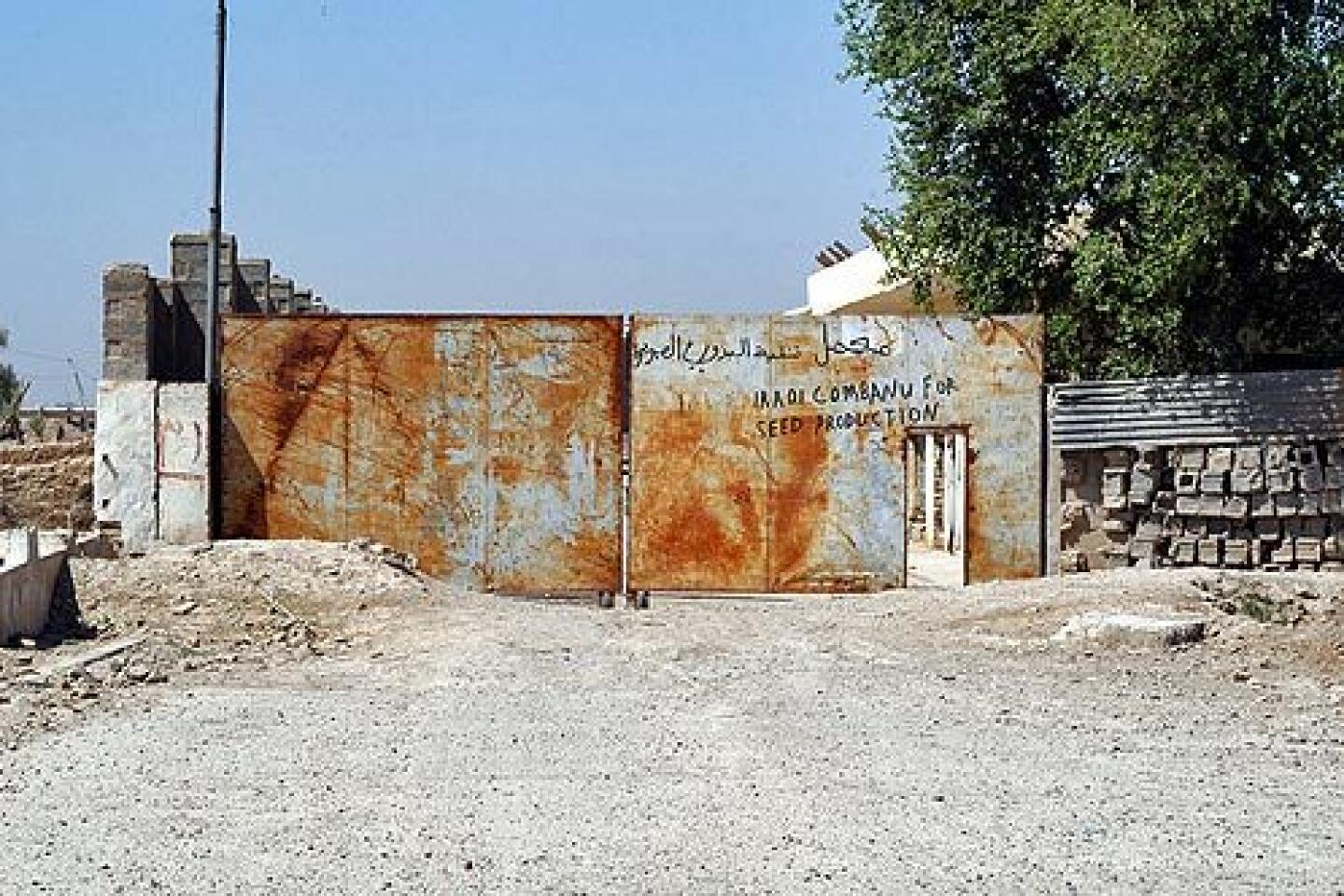
Behind a high wall, a two-story grain silo adjoined the warehouse that Curveball had identified as the truck assembly facility.
“That’s the one where the mobile labs were supposed to be,” said a former U.N. inspector who worked with the U.S. and other intelligence agencies. “That’s the one we were interested in.”
The doors were locked, so Boston microbiologist Rocco Casagrande climbed on a white U.N. vehicle, yanked open a metal flap in the wall, and crawled inside. After scrambling over a huge pile of corn, he scraped two samples of residue from cracks in the cement floor, two more from holes in the wall and one from a discarded shower basin outside.
Back at the Canal Hotel that afternoon, he tested the samples for bacterial or viral DNA. He was searching for any signs that germs were produced at the site or any traces of the 1998 bio-weapons accident. Test results were all negative.
“No threat agents detected,” Casagrande wrote in his computer journal that night. “Got to climb on a jeep and crawl into buildings and play second-story man, but otherwise spent the day in the lab.”
A British inspector, who had helped bring the intelligence file from New York, found another surprise.
Curveball had said the germ trucks could enter the warehouse from either end. But there were no garage doors and a solid, 6-foot-high wall surrounded most of the building. The wall British intelligence saw in 1997 satellite photos clearly made impossible the traffic patterns Curveball had described.
U.N. teams also raided the other sites Curveball had named. They interrogated managers, seized documents and used ground-penetrating radar, according to U.N. reports.
The U.N. inspectors “could find nothing to corroborate Curveball’s reporting,” the CIA’s Iraq Survey Group reported last year.
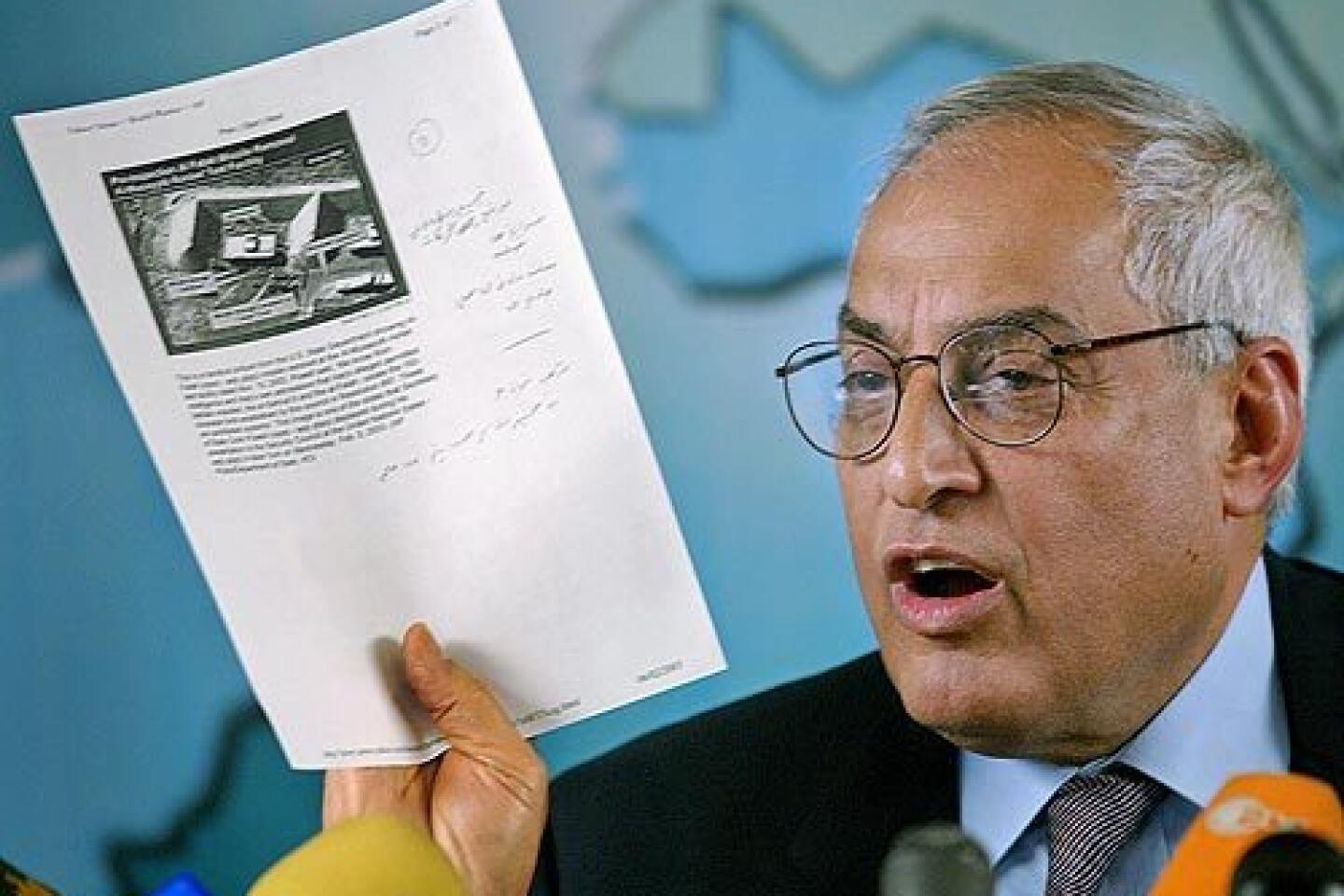
On March 7, 2003, Hans Blix, the chief U.N. inspector, told the Security Council that a series of searches had found “no evidence” of mobile biological production facilities in Iraq. It drew little notice at the time.
The invasion of Iraq began two weeks later.
Phantom labs
Soon after U.S. troops entered Baghdad, the discovery of two trucks loaded with lab equipment in northern Iraq brought cheers to the CIA weapons center.
Curveball examined photos relayed to Germany and said that while he hadn’t worked on the two trucks, equipment in the pictures looked like components he had installed at Djerf al Nadaf.
Days later, the CIA and DIA rushed to publish a White Paper declaring the trucks part of Hussein’s biological warfare program. The report dismissed Iraq’s explanation that the equipment generated hydrogen as a “cover story.” A day later, Bush told a Polish TV reporter: “We found the weapons of mass destruction.”
But bio-weapons experts in the intelligence community were sharply critical. A former senior official of the State Department’s Bureau of Intelligence and Research called the unclassified report an unprecedented “rush to judgment.”
The DIA then ordered a classified review of the evidence. One of 15 analysts held to the initial finding that the trucks were built for germ warfare. The sole believer was the CIA analyst who helped draft the original White Paper.
Hamish Killip, a former British army officer and biological weapons expert, flew to Baghdad in July 2003 as part of the Iraq Survey Group, the CIA-led Iraqi weapons hunt. He inspected the truck trailers and was immediately skeptical.
“The equipment was singularly inappropriate” for biological weapons, he said. “We were in hysterics over this. You’d have better luck putting a couple of dust bins on the back of the truck and brewing it in there.”
The trucks were built to generate hydrogen, not germs, he said. But the CIA refused to back down. In March 2004, Killip quit, protesting that the CIA was covering up the truth.
Rod Barton, an Australian intelligence officer and another bio-weapons expert, also quit over what he said was the CIA’s refusal to admit error. “Of course the trailers had nothing to do with Curveball,” Barton wrote in a recent e-mail.
The Iraq Survey Group ultimately agreed. An “exhaustive investigation” showed the trailers could not “be part of any BW program,” it reported in October 2004.
The now-discredited CIA White Paper remains on the agency’s website. A CIA spokesman said the report was posted because it was part of the historical record.
After U.S troops failed to find illicit Iraqi weapons in the days and weeks after the invasion, the CIA created the Iraq Survey Group to conduct a methodical search in June 2003.
Tenet appointed Kay to head it. The pugnacious Texan was convinced that Baghdad had hidden mobile germ factories. Kay’s teams returned to Djerf al Nadaf and other sites identified by Curveball.
One CIA-led unit investigated Curveball himself. The leader was “Jerry,” a veteran CIA bio-weapons analyst who had championed Curveball’s case at the CIA weapons center. They found Curveball’s personnel file in an Iraqi government storeroom. It was devastating.
Curveball was last in his engineering class, not first, as he had claimed. He was a low-level trainee engineer, not a project chief or site manager, as the CIA had insisted.
Most important, records showed Curveball had been fired in 1995, at the very time he said he had begun working on bio-warfare trucks. A former CIA official said Curveball also apparently was jailed for a sex crime and then drove a Baghdad taxi.
Jerry and his team interviewed 60 of Curveball’s family, friends and co-workers. They all denied working on germ weapons trucks. Curveball’s former bosses at the engineering center said the CIA had fallen for “water cooler gossip” and “corridor conversations.”
“The Iraqis were all laughing,” recalled a former member of the survey group. “They were saying, ‘This guy? You’ve got to be kidding.’ ”
Jerry tracked down Curveball’s Sunni Muslim parents in a middle-class Baghdad neighborhood.
“Our guy was very polite,” Kay recalled. “He said, ‘We understand your son doesn’t like Americans.’ His mother looked shocked. She said, ‘No, no! He loves Americans.’ And she took him into [her son’s] bedroom and it was filled with posters of American rock stars. It was like any other teenage room. She said one of his goals was to go to America.”
The deeper Jerry probed, the worse Curveball looked.
Childhood friends called him a “great liar” and a “con artist.” Another called him “a real operator.” The team reported that “people kept saying what a rat Curveball was.”
Jerry and another CIA analyst abruptly broke off the investigation and took a military flight back to Washington. Kay said Jerry appeared to be nearing a nervous breakdown.
“They had been true believers in Curveball,” Kay said. “They absolutely believed in him. They knew every detail in his file. But it was total hokum. There was no truth in it. They said they had to go home to explain how all this was all so wrong. They wanted to fight the battle at the CIA.”
Back home, senior CIA officials resisted. Jerry was “read the riot act” and accused of “making waves” by his office director, according to the presidential commission. He and his colleague ultimately were transferred out of the weapons center.
The CIA was “very, very vindictive,” Kay said.
Soon after, Jerry got in touch with Michael Scheuer, a CIA analyst who felt he had been sidelined for criticizing CIA counterterrorism tactics. Scheuer would quit within a year.
“Jerry had become kind of a nonperson,” Scheuer recalled of their meeting. “There was a tremendous amount of pressure on him not to say anything. Just to sit there and shut up.”
A CIA spokeswoman confirmed the account, but declined to comment further. Jerry still works at the CIA and could not be contacted for this report. His former supervisor, reached at home, said she could not speak to the media. “What was done to them was wrong,” said a former Pentagon official who investigated the case for the presidential commission. “But we didn’t see it so much as a cover-up as an expression of how profoundly resistant to recognizing mistakes the CIA culture was.”
Kay’s findings
In December 2003, Kay flew back to CIA headquarters. He said he told Tenet that Curveball was a liar and he was convinced Iraq had no mobile labs or other illicit weapons. CIA officials confirm their exchange.
Kay said he was assigned to a windowless office without a working telephone.
On Jan. 20, 2004, Bush lauded Kay and the Iraq Survey Group in his State of the Union Speech for finding “weapons of mass destruction-related program activities.... Had we failed to act, the dictator’s weapons of mass destruction program would continue to this day.”
Kay quit three days later and went public with his concerns.
In Germany, the BND finally agreed to let the CIA interview Curveball. The CIA sent one of its best officers, fluent in German and gifted at working reluctant sources.
They met at BND headquarters in Pullach, a suburb of Munich, in mid-March 2004 -- one year after the Iraq invasion.
Alone with Curveball at last, the CIA officer steadily reviewed details and picked at contradictions like a prosecutor working a hostile witness. He showed spy satellite images and other evidence from the sites Curveball had identified.
Each night, he would file an encrypted report to CIA headquarters on his computer, and then call Drumheller.
“After the first couple of days, he said, ‘This doesn’t sound good,’ ” Drumheller recalled. “After the first week, he said, ‘This guy is lying. He’s lying about a bunch of stuff.’ ”
But Curveball refused to admit deceit. When challenged, he would mumble, say he didn’t know and suggest the questioner was wrong or the photo was doctored. As the evidence piled up, he simply stopped talking.
“He never said, ‘You got me,’ ” Drumheller said. “He just shrugged, and didn’t say anything. It was all over. We told our guy, ‘You might as well wrap it up and come home.’ ”
It took more than a month to track and recall every U.S. intelligence report -- at least 100 in all -- based on Curveball’s misinformation. In a blandly worded notice to its stations around the world, the CIA said in May 2004:
“Discrepancies surfaced regarding the information provided by ... Curveball in this stream of reporting, which indicate that he lost his claimed access in 1995. Our assessment, therefore, is that Curveball appears to be fabricating in this stream of reporting.”
The CIA had advised Bush in the fall of 2003 of “problems with the sourcing” on biological weapons, an official familiar with the briefing said. But the president has never withdrawn the statement in his 2003 State of the Union speech that Iraq produced “germ warfare agents” or his postwar assertions that “we found the weapons of mass destruction.”
U.S., British and German intelligence officials still debate what Curveball really saw, and what he really did. One possible answer was buried in records the Iraq Survey Group recovered at the engineering and design center in Baghdad.
They show that Iraqi officials considered installing seed handling gear on trucks in 1995, but instead put the machinery in warehouses, like those at Djerf al Nadaf. Perhaps Curveball heard about the modified trucks and spun them into a bio-weapons system for gullible intelligence agencies.
“You’re left at the end with uncertainty,” said the former CIA official who helped supervise the Curveball case and the postwar investigation. “We know what he said. We know we don’t believe him. But was he making it all up? Was he coached? Did he hear something and then embellish it? These things are still unresolved.”
Not for Curveball. “He is convinced his story is true,” said the BND analyst. “He has no doubts to this day.”
*
Drogin is a Times staff writer. Goetz is a special correspondent. Also contributing to this report from Baghdad was staff writer Jeffrey Fleishman.
*
(BEGIN TEXT OF INFOBOX)
Key developments
1991
Gulf War ends
Saddam Hussein loses the Gulf War and orders aides to destroy stocks of germ-filled bombs. Regime officials lie to U.N. inspectors about prewar program and hide evidence of biological warfare factories.
1992
U.N. acts
A U.N. weapons inspector speculates in a memo that Iraq may be using mobile germ production facilities to hide its bio-warfare program. U.N. launches unsuccessful raids to find the suspected germ trucks.
1994
Curveball gets job
Curveball is hired out of engineering school at Baghdad University to work at the Chemical Engineering and Design Center. He says he is first in his class, but records later show that he was last in his class.
May 1995
Enter ‘Dr. Germ’
Curveball says he is assigned to help his boss, Dr. Rihab Taha, also known as “Dr. Germ,” as she begins planning for secret assembly of vehicles that can brew deadly germs and avoid detection.
July 1995
An Iraqi admission
Regime officials admit to U.N. inspectors that Iraq produced and weaponized anthrax, botulinum toxin, aflatoxin and other biological poisons before the Gulf War. CIA analysts suspect Baghdad has secret mobile labs.
July 1997
Germ truck
Curveball says he helped assemble a germ-production unit on trucks at Djerf al Nadaf. But the Iraqi says he did not see the unit in use, and did not know what germs it was designed to produce.
Fall 1998
Accident rumors
Curveball says an accident at Djerf al Nadaf kills 12 bio-warfare technicians. The CIA later says Curveball witnessed the accident and was injured, but Germans say he only heard “rumors” of incident.
November 1999
Move to Germany
Curveball applies for political asylum in Germany. He tells German intelligence for first time that he built germ weapons trucks. U.S. investigators later conclude he conjured up story to obtain visa.
January 2000
Curveball talks
German intelligence officers first interrogate Curveball. They refuse to let U.S. operatives meet him. But summaries of his information are quickly provided to senior U.S. policymakers.
May 2000
Doubts raised
Doubts emerge about Curveball. A CIA doctor, posing as a German, meets the defector and reports he spoke “excellent English.” German officials say Curveball has emotional problems.
September 2001
9/11 raises profile
The Germans complete interrogations of Curveball. 9/11 terror attacks raise U.S. concerns about Saddam Hussein. CIA reassesses Curveball reports and sharply increases warnings of Iraq’s germ weapons.
Fall 2002
A CIA warning
A German intelligence official tells Tyler Drumheller that Curveball may be a fabricator. Drumheller tries to warn others at the CIA. But U.S. intelligence concludes that Iraq has greater bio-warfare capabilities.
February-March 2003
Powell speaks
Colin Powell warns U.N. that the mobile labs Curveball described can kill thousands of people. U.N. inspectors visit Djerf al Nadaf and other sites in Iraq but find no evidence. U.S. invades Iraq.
May 2003
Bush affirms WMD
U.S. find two trucks with lab equipment. Curveball identifies some items. President Bush announces finding weapons of mass destruction. CIA determines the vehicles cannot be used for biological weapons.
Fall 2003
Story unravels
CIA-led investigators discover Curveball was fired in 1995, and could not have worked on bio-weapons. Friends call him a liar and a fraud. “Jerry,” a CIA official, tries to convince senior officials of their mistake.
March-May 2004
CIA closes case
Germans allow the U.S. to interview Curveball. He refuses to admit deceit, but CIA case officer is convinced he is lying. CIA declares Curveball a fabricator and withdraws all reports based on his accounts.


Sign up for Essential California
The most important California stories and recommendations in your inbox every morning.
You may occasionally receive promotional content from the Los Angeles Times.